- Titanium Court is a strategy roguelike that splits each turn into a High Tide (match three coloured tiles in a line for resources) and a Low Tide (spend those resources to deploy soldiers or farmers).
- It won the IGF 2026 Seumas McNally Grand Prize and the Excellence in Design award on April 23, 2026, and is currently 20% off on Steam at around $16.
- If you like Into the Breach's tight tactical loops or Slay the Spire's deckbuilding momentum, the genre fusion will feel familiar — just weirder, with mountains you can place to slow enemies down.
- Beginners should pick a single Court archetype, ignore the side jobs on run one, and accept that losing track of what each rival Court does is normal in your first three runs.
Why I'm Writing This Before Playing
A small honest note up front. I haven't bought Titanium Court yet. I usually play a game for at least a few hours before writing anything about it on LevelWalks, but this one won the IGF 2026 Seumas McNally Grand Prize five days ago and the wave of "what is this game" searches is happening right now. Waiting two weeks until I have a full personal playthrough means writing into an empty room.
So this isn't a walkthrough. It's a buyer's-side explainer based on the past few days reading the Kotaku, PC Gamer, and AVClub reviews, watching about three hours of gameplay clips on YouTube, and going through the Steam Community discussions. If you're trying to figure out what kind of game this actually is before spending around $16, that's what I can help with right now. The deeper walkthrough comes after I've put real time into a save file.
What Is Titanium Court?
Titanium Court is a strategy roguelike from solo developer AP Thomson, published by Fellow Traveller (the same label behind Citizen Sleeper and Going Under). It launched on Steam on April 23, 2026, after several years of festival demos. You play as one of several rival "Courts" — strange, semi-allegorical factions — competing for territory across procedurally arranged battles.
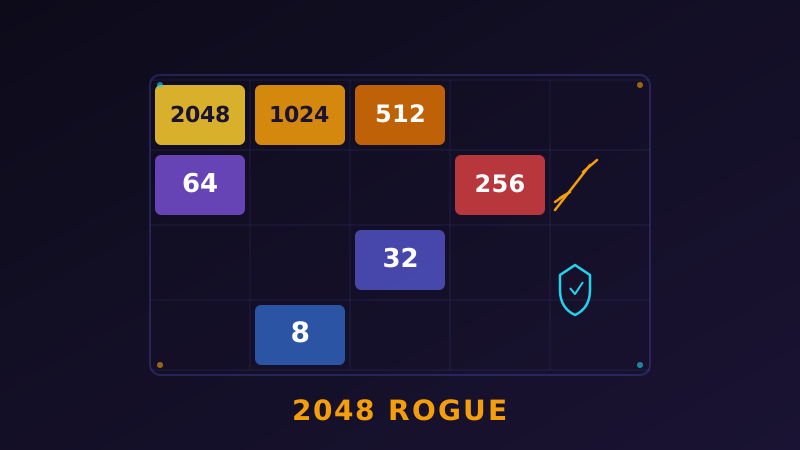
The structural twist is that every turn splits into two phases. In High Tide, you play a match-3 puzzle on a small grid to gather resources. In Low Tide, those resources get spent on soldiers (who fight), farmers (who gather more resources during combat), or terrain manipulation (placing mountains to slow enemies, for example). Win the engagement, advance the run, repeat with new modifiers and a new Court matchup.
It is, by genre tag, four things at once — match-3 puzzler, tower defense, roguelike, and tactical strategy. Reviewers have leaned on "surreal" and "story-heavy" to describe the tone. Looking at gameplay clips, the visual style is deliberately strange: hand-drawn courts, oddly proportioned soldiers, dreamlike colour palettes that shift between battles. Not the cosy aesthetic of most match-3 games.
How High Tide and Low Tide Actually Work
From watching about a dozen run videos, here's the loop as best I can describe it without having played a single match myself.
High Tide — the puzzle phase
A board of coloured tiles appears, similar to Bejeweled or Puzzle Quest, but smaller and turn-based. You match tiles in lines of three (or longer) to generate resources. Each tile colour maps to a different resource type — wood, stone, food, gold (the names vary by Court archetype). PC Gamer's review noted that High Tide rewards setting up cascading matches rather than just chasing the longest line, because chains push you over key resource thresholds for the next phase.
Low Tide — the deployment phase
Resources from High Tide convert into deployable units in Low Tide. Soldiers cost more but engage enemy Courts directly. Farmers are cheap and gather extra resources during combat, but they're vulnerable. Terrain pieces — placing mountains, trenches, or walls — cost a different resource type and shape how enemies move toward you. The Kotaku review specifically called out the "arrange mountains near your court to slow enemies" decision as the single mechanic that makes Titanium Court click for some players.
The interlock
What makes the loop interesting (and what I'm most curious to feel for myself) is that the match-3 board persists between turns within an engagement. So weak High Tide turns leave the board in awkward states for next round. Strong cascades clear the board and refresh it favorably. There's a feedback loop between puzzle skill and tactical resourcing that doesn't exist in most match-3 RPGs, where the puzzle phase usually runs on its own track.
Match-3 vs Roguelike vs Tower Defense — Which Wins?
If you're trying to figure out which of your existing favourite games Titanium Court most resembles, here's a rough comparison drawn from the gameplay clips and reviews. I'd take this with a grain of salt — genre comparisons get fuzzier the more hybrid a game is, and Titanium Court is unusually hybrid.
| Game | Phase Loop | Run Length | Comeback Potential |
|---|---|---|---|
| Titanium Court | Match-3 → deploy → battle (interlocked) | ~45-60 min | High — strong cascade can swing a losing engagement |
| Into the Breach | Pure tactical grid (no resource sub-phase) | ~30-40 min | Low — every move telegraphed, mistakes compound |
| Slay the Spire | Card draw → play → resolve (deckbuilder) | ~60-90 min | Moderate — depends on deck synergy not turn timing |
| Puzzle Quest | Match-3 → spell trigger (independent phases) | ~10-15 min per battle | High — single match cascade can finish opponent |
The closest cousin is probably Puzzle Quest in pure mechanic terms, but Titanium Court adds a deployment layer Puzzle Quest doesn't have, plus the roguelike run structure that Puzzle Quest definitely doesn't have. The closest cousin in feel is probably Into the Breach — that same sense of "every decision matters and the board state is small enough to think about completely" — except with a puzzle phase grafted onto the front of every turn.
Why It Won the IGF Grand Prize
The Independent Games Festival's Seumas McNally Grand Prize is the top award at IGF and goes to one game per year out of hundreds of entries. Titanium Court won it at the 2026 ceremony, plus the Excellence in Design award, and was nominated in two more categories.
Reading between the lines of the reviews, the consensus is that the genre fusion isn't a gimmick — the High Tide and Low Tide phases meaningfully feed into each other rather than feeling like two separate games stapled together. AVClub called it "a most rare video game vision," which is the kind of phrase reviewers reach for when they can't easily compare a game to anything else. ScreenHub said it "defies description," same idea.
The Fellow Traveller publishing fingerprint matters here too. They lean toward unusual narrative-leaning indie projects (In Other Waters, Citizen Sleeper, Paradise Killer), so a strategy roguelike with story emphasis fits their catalogue exactly. If you trust their curation, that's a useful signal on its own.
Should You Buy It Right Now?
The Steam launch discount of 20% drops the price to roughly $16 from the $20 base. That window typically closes about a week after release, so by early May you'll likely be paying full price.
Here's how I'd think about it depending on your taste:
- If you already love Into the Breach or Slay the Spire, the genre overlap is strong enough that buying at launch discount makes sense. The interlocked match-3 layer is the new thing you'd be paying to experience.
- If you've bounced off match-3 games before, this probably isn't the one that converts you. The puzzle phase is genuinely about line-matching skill, not just window dressing.
- If you mostly play casual mobile puzzlers, the strategy and roguelike layers will likely feel heavy. The reviews specifically mention some players "losing track of how different courts worked" — there's a learning curve.
- If you're on the fence, the demo from earlier festival circuits is still up on the Steam store page. About 45 minutes of playtime should tell you whether the loop clicks.
My personal call: I'm going to wait until the weekend, mostly because I have two other games I committed to finishing first. The 20% discount probably stays through early May based on Fellow Traveller's past launches, so the urgency isn't extreme.
What I'll Be Looking For When I Play
When I do start a save file, four things I'll specifically test before writing the deeper walkthrough:
- Does the board state really persist meaningfully? The interlocked match-3 / tactical loop is the headline mechanic. I want to know if a bad High Tide actually punishes you for two or three turns, or if the resource cost smooths it over.
- How distinct are the Court archetypes? Reviews mention multiple Courts with different styles. I'll start three runs with three different Courts and see if the strategic feel shifts substantially or just nominally.
- Where does the difficulty curve sit? First three runs are usually "learning the systems." I'll track when the first genuine challenge run appears and whether the difficulty ramps from there.
- Is the story actually doing anything? AVClub and ScreenHub mention the surrealism and the narrative weight. I want to see if it integrates with the mechanics or sits beside them.
Once I've got 8-10 hours in and a few completed runs, I'll publish the full walkthrough with deck-building advice, Court-by-Court strategies, and the deeper combat patterns. Sub-optimal opening moves, breakpoint resource thresholds, the works. Probably mid-May based on my actual play schedule.
Frequently Asked Questions
Is Titanium Court hard for beginners?
Based on review consensus, the first two or three runs are genuinely confusing because you're learning the match-3 layer, the deployment layer, and the rival Court behaviors at the same time. Several reviewers mentioned getting overwhelmed early. The good news is that runs are short — roughly 45 to 60 minutes — so the cost of a failed learning run is low. Sticking with one Court archetype for the first few attempts is the most-cited beginner advice.
How long is a single run?
Roughly 45 to 60 minutes for a complete run, based on the gameplay videos I've watched. That's a middle ground between Into the Breach (typically 30-40 minutes) and Slay the Spire (60-90 minutes). Failed early runs end faster, sometimes in 15-20 minutes if you misread a Court matchup. Successful late-game runs can stretch past 90 minutes if you're playing carefully through the final battles.
Is it more like Bejeweled or Slay the Spire?
More like Slay the Spire in structure, more like Bejeweled in moment-to-moment input. You're managing a roguelike run with branching decisions, but the actual mechanic you're using to do that includes a match-3 puzzle on every turn. People who liked Puzzle Quest's match-3-plus-RPG combination will recognize the shape, except the meta-layer here is a roguelike strategy game rather than a JRPG.
When will the deeper walkthrough come?
After I've actually played enough to write something useful — probably mid-May, after I've completed a few full runs and tested at least three Court archetypes. The plan is one main beginner walkthrough plus two or three sibling guides covering specific Courts and the harder difficulty modes. I'll link them back to this page when they're up.
What platforms can I play it on?
Titanium Court launched on Steam (Windows and Mac) on April 23, 2026. There's no console or mobile release announced yet, though Fellow Traveller has historically brought their catalogue to Switch within six to twelve months of PC launch. If you're hoping for a Steam Deck experience specifically, the gameplay clips suggest it should run well — the visual style isn't graphics-heavy and the controls are mostly point-and-click.
Jim Liu runs LevelWalks and writes puzzle game guides from a small flat in Sydney. He's covered Brain Test, Monument Valley 3, Block Blast, and roughly 40 other puzzle games over the past few months. Most are walkthroughs written after actually playing through; this one is a pre-purchase explainer because the IGF win deserved a same-week response. The full walkthrough is coming after he's put real time into a save file.
Field Notes: First Week Actually Playing Titanium Court (May 2026)
I bought it on a Saturday evening in early May, roughly ten days after writing the pre-purchase explainer above. Played on my desktop (Windows 11, Steam version 1.0.3) with a mouse and keyboard. I kept a rough log in a notes app because I knew I'd want to report back. What follows is what actually happened — not a polish pass, just the notes.
Run one lasted maybe 22 minutes. I picked the first Court (the one that looked like an officious little bureaucracy, grey seal, marching soldiers) and immediately got overwhelmed in the second engagement when I found out I was doing completely the wrong thing with the board state. I was clearing tiles randomly instead of setting up cascades. Lost with no real understanding of why.
Run two was where the board-state persistence question from the pre-purchase section got answered. Yes, it actually punishes you. I had three turns in a row where my High Tide was hemmed into a corner of the board with no useful matches available, and my Low Tide resources were so thin I could only afford two farmers per turn. By the time the enemy engagement hit, I had roughly four soldiers and a mountain range that the AI waltzed around by flanking from the south. Forty minutes in, dead again, and now I understood why.
Run three was my first completion. I switched Court archetypes to something that felt more like Slay the Spire — lots of small modifiers that stack rather than a few big decisions. Total time about 70 minutes, which is on the long side of the range the guide above mentioned. The match-3 cascade thing clicked somewhere around the fifth engagement. I genuinely felt a difference between a mediocre board turn and a strong one in terms of what I could afford in Low Tide.
The story is doing something. I am not sure what. Between engagements there are short text exchanges between Court representatives that feel like diplomatic negotiations gone sideways. I read all of them but I have the feeling you need three or four completed runs to understand the larger arc. On run one and two I had no context. By run three some names were familiar enough to follow. On run four — a failed run, deep into the Mansion equivalent — one of the exchanges hit differently because I remembered a prior conversation from run three. That's good design, but it requires patience.
One concrete discovery worth sharing: the mountain terrain pieces are more powerful than the reviews implied. I was placing them as general obstacles. After watching the enemy AI for two runs, I figured out they have route preferences — they'd rather go around than through, but they have a preferred direction when routing around. Mountains placed to the east of your Court forced them to the west where I'd concentrated soldiers. That's not documented anywhere in the game's own UI. I worked it out empirically over about four engagements.
One frustration: the game's tutorial is shorter than it should be. The first engagement in Run 1 teaches you the basic High Tide and Low Tide structure but doesn't explain what happens to the board when you complete a turn. I didn't know the board persisted until I noticed it myself on Run 2, turn 3. That's a design choice I respect (discovery over instruction) but it cost me an entire learning run.
What I Got Wrong
Three specific misconceptions I had going in that turned out to be wrong.
1. I thought farmers were basically useless. In the pre-purchase explainer above I described them as cheap but vulnerable. That's true. But I concluded from that description that soldiers were almost always better because you couldn't afford to lose farmers in a live engagement. Wrong. Farmers who survive an engagement and chain into your next High Tide create a resource multiplier that compounds across long runs. Runs where I ignored farmers entirely tended to collapse by the sixth or seventh engagement when my resource curve flattened. My successful runs used a rough 2:1 soldier-to-farmer ratio in the early engagements, leaning more on soldiers only as the final engagement approached.
2. I thought the Court archetypes were mostly cosmetic. They are not. I ran the same engagement scenario (second run, second engagement, same rival Court) with two different archetypes on two separate attempts. The tile colours available in High Tide are genuinely different between Court types, and the resource-to-unit conversion rates differ enough that the optimal board strategy changes. The archetype I found most interesting (the bureaucratic one from Run 1) produces stone heavily and can place terrain cheaply. The one I finished Run 3 with generates food efficiently and has cheap farmers. Same board game, different resource economy.
3. I assumed the rival Court behaviours were symmetrical. I expected that if I were playing one archetype against another, the mirror match would be possible — same mechanics, same tools. Not quite. Some rival Courts do things during Low Tide that your archetype can't: one rival I encountered in Run 4 placed fog tiles on the board during its Low Tide, which obscured my High Tide matching area on the next turn. My archetype had no equivalent disruptive mechanic. Learning which rivals do what is its own meta-game layer the pre-purchase explainer didn't anticipate.
Additional Questions After Playing
Does the board state actually matter as much as the reviews suggest?
More than the reviews suggest, if anything. A bad board turn doesn't just set you back one round — if the board state is bad and you make minimum matches to survive, the tiles left over are often the wrong colours for your archetype. Two bad turns in a row compounds into a resource crisis that takes three or four turns to recover from. By that point, the rival Court has usually closed the resource gap. The board is not a side activity. It's the engine.
Is the IGF award justified after actually playing?
I think so, though with a caveat. The first run experience is rough. If the IGF judges had only played a single run each, I doubt it wins. The game earns its prize across runs two through five or six, when the system legibility builds and the strategic depth reveals itself. If you bounce off Run 1 (which is very possible), you'd be forgiven for not understanding the hype. Push through to Run 3.
Is Steam Deck play comfortable?
I only played on desktop, but based on what I know of the control scheme (mostly point-and-click with some drag interactions on the board), it should be fine on Steam Deck. The text is readable at a distance. The tile grid is not tiny. The only concern would be the occasional dialogue exchanges between runs, which can be dense and might need the larger screen to read comfortably without squinting.
Can you complete the game without understanding the story?
Yes. The story and the game mechanics don't interlock in a way that requires understanding the narrative to win engagements. You can skip all the dialogue and complete runs successfully. But you'll miss what makes the game feel like a coherent world rather than a systems exercise. On my second full completion (Run 5) I read everything deliberately, and the game felt about 40% more interesting. The story is worth the time, just not mandatory.
What's the most useful thing to learn on your first run?
Don't clear the board greedily. The instinct when you see a long match is to take it because it scores more. Sometimes that's right. But if taking the long match leaves a corner of the board isolated with only off-colour tiles, you've created a resource drought for the next two turns. Identify which tiles you need for Low Tide before you start High Tide, then plan your matches to leave the board in a state that produces those tiles again. It sounds simple. It takes about two runs to actually do it consistently.